Your Parked Car Is a Power Plant
Electric cars spend 95% of their lives parked. A new generation of software is turning that idle time into grid stability, lower bills and for some drivers, free fuel.
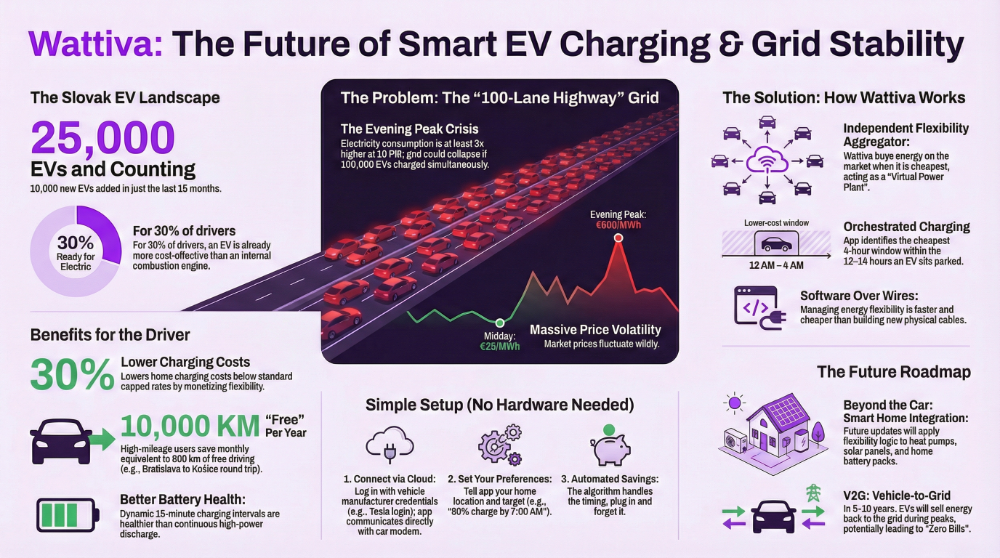
On a Tuesday evening in Bratislava, when the wholesale price of electricity spiked to €600 per megawatt-hour, roughly 25,000 electric vehicles across Slovakia were plugged in and waiting. Most of them didn't draw a single watt. By midnight, when the price collapsed to €20, they began to charge automatically, silently, without their owners lifting a finger. This is not the future of the power grid. It's already happening.
Standing Still Is the Point
Electric vehicles are often cast as the villains of the modern power grid story. In Slovakia and across the globe, a persistent skepticism suggests that as more drivers plug in, our aging infrastructure will inevitably buckle and "crash the grid."
The data reveals a paradox: the most valuable asset an electric vehicle offers is its capacity to stand still. Through orchestrated charging, your car becomes a node in a sophisticated neural network that stabilizes the grid, reduces energy costs, and potentially pays for its own fuel.
Building a Neural Grid through Energy Flexibility
The average car is stationary for roughly 95% of its life parked for 14 hours overnight or eight hours during a workday. Yet a typical daily commute requires only about two to three hours of active charging. This creates a massive window of Energy Flexibility.
By coordinating thousands of these stationary vehicles, software platforms like Wattiva create a "virtual power plant." An orchestrated system pulses with the needs of the grid, triggering charges during energy surpluses and pausing them during shortages. An uncoordinated grid, where every car draws power the moment it is plugged in, risks total system collapse during evening peaks.
Peter Hofierka, CTO of Wattiva, frames this shift as a fundamental infrastructure revolution:
"Software over wires. What can be solved through flexibility is better, cheaper, and faster than building new cables."
Hofierka's vision: coordinate enough EV flexibility to equal the capacity of Čierny Váh, Slovakia's largest pump-storage power plant at 735 MW. By using existing assets, a "threat" to the grid becomes its most reliable stabilizer.
The 30-Fold Price Trap: Exploiting Market Volatility
For the average consumer, electricity prices feel static, but the wholesale market tells a different story. Volatility is the only constant. Within a single 24-hour cycle, the price of a megawatt-hour can skyrocket from €20 at noon (when solar production peaks) to €600 during the evening rush.
That's a 30-fold increase within hours. Electric vehicle charging costs are dictated by when you draw power, not how much you use. Orchestrated charging exploits 15-minute and one-hour market windows to buy energy only when it is cheapest. By automating this "buy low" strategy, software turns the volatility of renewable energy into a direct financial benefit for the driver.
The 30% Reality Check: Breaking the Political Haze
Slovakia currently trails Europe in EV adoption, with roughly 25,000 electric cars on the road—though momentum is building, with 10,000 of those added in the last 15 months. Only 5-6% of new car buyers currently choose electric, but a pragmatic financial reality is being obscured by a "political haze."
Research indicates that for 30% of the Slovak population, an electric vehicle is already the more financially advantageous choice today. Even accounting for higher acquisition costs, the dramatically lower operating and service expenses make EVs the logical winner for nearly one-third of the country. The gap between 6% adoption and 30% feasibility is a failure of communication and public perception, not technology.
Zero Hardware, Maximum Intelligence
A common barrier to entry is the belief that "smart charging" requires expensive electrical upgrades or high-end "smart" wallboxes. The future of the grid is hardware-free. Platforms like Wattiva communicate directly with the car via the manufacturer's built-in cloud and modem.
If your vehicle has a native app that allows you to check battery levels or pre-heat the cabin, it is likely compatible with orchestrated charging. This software-first approach currently supports 70-80% of EV brands on the market. By bypassing the need for expensive hardware, the barrier to entry is eliminated, allowing the average user to join the "virtual battery" network without an electrician's visit.
Turning Drivers from Debtors into Partners
The traditional relationship between a consumer and a utility provider is one of debt: you use power, you pay the bill. Orchestrated charging flips this script. Your EV provides vital stabilization services to the grid, and you get paid for it.
Users receive cash rewards or credits on their energy bills for the flexibility they provide. For high-mileage drivers or households with significant energy consumption, these rewards add up: under certain circumstances, users generate enough credit to cover 10,000 km of driving per year for free. On a monthly basis, this often translates to roughly 800 km of free driving—enough for a round trip from Bratislava to Košice at no cost to the owner.
A "Zero Bills" Future
The integration of EVs is the first step toward a total Home Energy Management (HEM) revolution.
Marting Gonda, the CEO of Wattiva, is very clear about what the goal is:
"Our goal is to evolve into a unified application for the entire household. By managing the flexibility of not just EVs, but also heat pumps, stationary home batteries, and solar panels, we are moving toward a 'Zero Bills' future. We want to pair energy consumption with renewable sources so perfectly that electricity becomes effectively free for the consumer."
Critics warn that electric vehicles will overwhelm aging infrastructure. The data suggests the opposite: when orchestrated correctly, parked cars become a distributed power network that stabilizes the grid. And might even pay drivers for the privilege.
Conclusion: The Software-Driven Leap
Slovakia may be at the back of the pack in European EV numbers, but the country is poised for a software-driven leap. As energy prices rise and grid volatility increases, the ability to trade on flexibility will shift from a niche advantage to an economic necessity.
The technology to turn your driveway into a profit center already exists. Your car can pay for your home's electricity while sitting in the driveway.