
The Math Behind Your Electricity Bill
Fixed-rate electricity customers pay a 'risk premium' that vanishes the moment you automate your consumption.
In the 1960s, German utilities solved a surplus problem by selling overnight electricity at a discount. Millions of households bought brick-filled radiators that stored cheap heat while they slept. Six decades later, we have electric vehicles, heat pumps, and home batteries. But most of us still pay for power as if the spinning-disk meter never evolved.
This article is the master class on Dynamic Electricity Pricing. We are going to move beyond the marketing slogans and look at the actual math, the market mechanics, and the hardware you need to stop overpaying for electrons.
Your Electric Bill Is Stuck in 1960
In the 1960s, the German energy grid faced a unique problem. Power plants were running full throttle all night, but the country was asleep. The electricity was being generated, but nobody was using it.
To solve this, utility companies introduced “night-time tariffs,” selling electricity at a steep discount between 8 PM and 6 AM. The result was the adoption of massive “night storage heaters”. Heavy, brick-filled radiators that soaked up cheap energy while you slept and released the heat the next day. It was a brilliant solution for the analog age.
Fast forward to today. We have electric vehicles (EVs), heat pumps, and home batteries. Our technology has evolved, yet many of us are still paying for electricity like it’s 1960 with a flat, fixed rate.
Here is the hard truth: If you are paying a flat rate, you are actively subsidizing the inefficiency of the grid.
The "Flat Rate" Premium
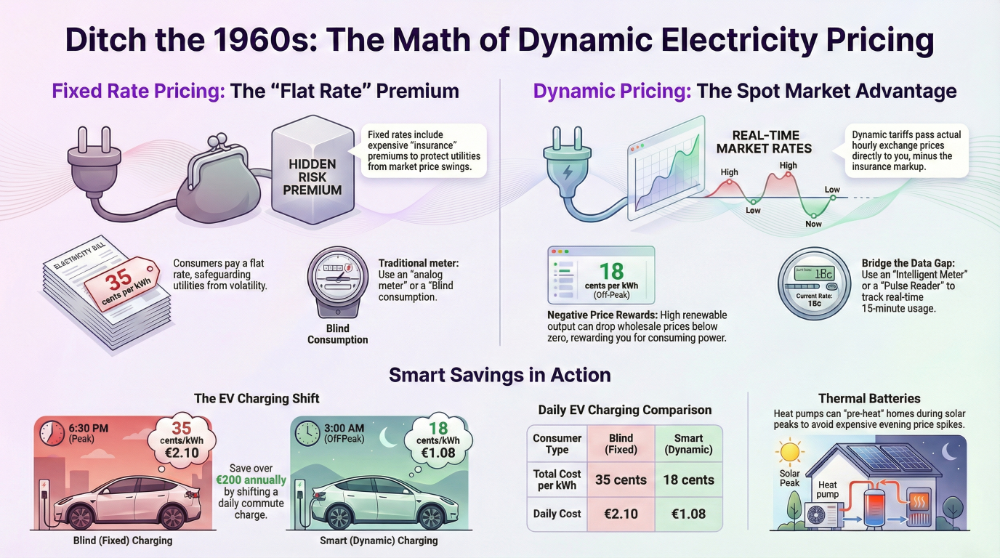
To understand why you are overpaying, you first need to understand what you are actually paying for. When you sign a standard fixed-rate contract, for example 35 cents/kWh for 12 months, you are buying insurance.
The energy market is wild. Wholesale prices can swing from negative values to over €500 per MWh in a matter of hours. Your utility company knows this. To offer you a stable price, they calculate the average expected price for the year, add a hefty "risk premium" to protect themselves from volatility, and layer on their profit margin.
You pay that premium every single second. You pay it at 2:00 PM on a sunny Sunday when energy is virtually free, and you pay it at 3:00 AM when the wind is howling and the grid is overloaded with power. By staying on a fixed tariff, you are effectively paying extra for the luxury of not having to think about your energy usage. For a standard household with just a fridge and a TV, that might be a fair trade. But if you own an EV or a heat pump, that "insurance" is costing you hundreds of euros a year.
Dynamic Pricing Explained
Dynamic Pricing, often called a "Spot Market Tariff," removes the insurance premium entirely. Instead of a safety-buffer price, your provider passes the actual hourly exchange price directly to you, plus a small monthly administration fee.
Most of Europe’s electricity price is determined at the EPEX SPOT exchange in Paris. The process works through a massive daily auction at 12:00 CET. Energy generators, such as wind farms and nuclear plants, submit how much power they can produce for the following day, while buyers submit their requirements. The algorithm matches supply and demand hour-by-hour—and increasingly in 15-minute intervals.
By early afternoon, the results are published. This offers total transparency to the consumer; you can see exactly what electricity will cost at 11:00 AM tomorrow versus 6:00 PM tomorrow, allowing you to plan your consumption accordingly.
The "Duck Curve" and Negative Prices
This market mechanic leads to a fascinating phenomenon known as Negative Pricing. Because Europe has aggressively adopted solar and wind, we now see hundreds of hours annually where the wholesale price of electricity drops below zero. In 2024 and 2025, countries like the Netherlands, Finland, and Germany experienced this regularly.
This occurs due to a specific combination of factors: oversupply, inflexibility, and subsidies. On a sunny, windy Sunday in July, renewable generation is maxed out. However, old coal or nuclear plants cannot simply turn off for two hours, as it takes days to restart them, so they keep running. Furthermore, subsidy rules often pay older renewables to produce regardless of market price. When this happens, the grid becomes desperate to offload energy. If you have a dynamic tariff, the energy portion of your bill turns negative. You are literally helping stabilize the grid by consuming power, and the market rewards you for it.
The "Smart Savings" Math
Let’s break down the bill, as this is the part most blogs skip despite it being crucial for your financial calculations. Your electricity price per kWh is essentially a layer cake made of three wedges.
The first two layers are generally fixed. These are the Taxes & Levies (VAT, electricity tax, concession fees) and the Grid Fees (the cost to transport power to your house). In high-cost markets like Germany, these fixed components make up roughly 50% of the price. The third layer is Energy Procurement, or the cost of the electricity itself. This is the dynamic part where the savings happen. In the Nordics, this portion is larger, meaning dynamic savings are even higher, but the principle remains the same across Europe.
The Commuter Case Study
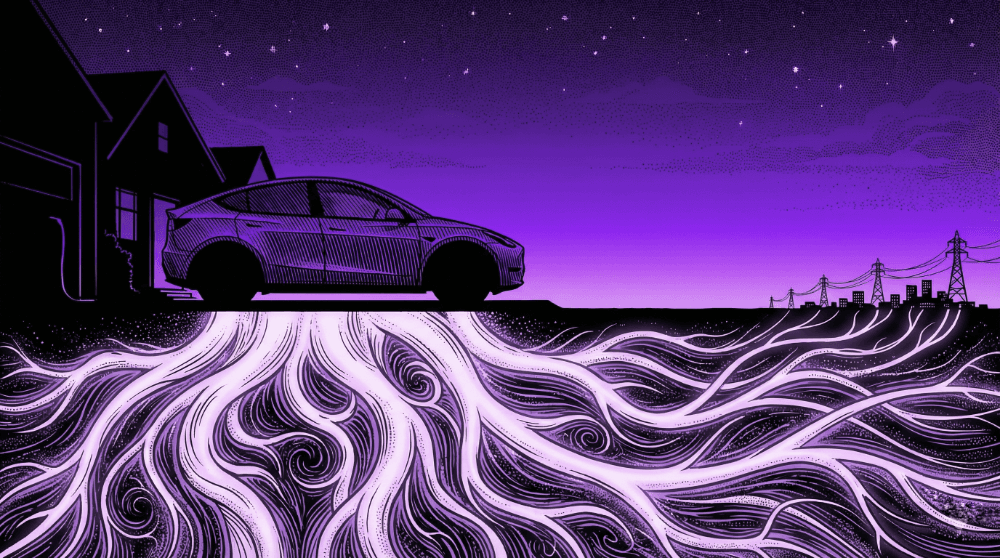
To see this in action, let’s look at a concrete example of a German commuter driving a Tesla Model Y roughly 34 km a day (approx. 6 kWh usage).
In Scenario A, our "Blind Consumer" is on a fixed rate of 35 cents/kWh. They come home at 6:30 PM - peak usage time - and plug in immediately. This habit costs them €2.10 per day.
In Scenario B, the "Smart Consumer" utilizes a dynamic rate. Their fixed grid and tax component is roughly 16 cents. At 6:30 PM, the spot price is 15 cents, making the total cost 31 cents. However, at 3:00 AM, the spot price drops to 2 cents, bringing the total to just 18 cents. Even though they plug in at 6:30 PM, their app automatically pauses charging until the car wakes up at 3:00 AM when wind power is peaking. This reduces the daily cost to €1.08.
The delta is significant. You save €1.02 per day simply by shifting the load. Assuming a standard 5-day commute over 220 working days, that is approximately €224 per year just for charging your car while you sleep. If you add a heat pump to the mix, the savings compound further. Heat pumps act as "thermal batteries," allowing you to overheat your house slightly at 2:00 PM when solar is cheap and turn the pump off during the evening price spikes, coasting on the stored heat.
What Do You Need?
You cannot access dynamic pricing with an old mechanical "ferrari" meter, the one with the spinning disk. You need digital granularity.
In Europe, the gold standard is the Intelligent Metering System (iMSys) or Smart Meter Gateway. This fully connected meter sends data to your provider every 15 minutes via a secure cellular connection, making you ready instantly. However, many households, particularly in Germany, have a "Modern Measuring Device" (mME). This is digital but "dumb," meaning it doesn't send data.
Fortunately, there is a hack. If you have an mME, you can often use a "Pulse Reader," such as the Tibber Pulse. This small device attaches magnetically to the infrared port on your meter and bridges the data to your Wi-Fi, essentially turning a dumb digital meter into a smart one without a costly electrician visit.
Is It Risky?
Critics of dynamic pricing often point to the Texas winter crisis of 2021, where people on wholesale plans received bills for thousands of dollars because prices exploded during a storm.
While prices can technically spike in Europe, consumer protection is stronger here, and our market is highly interconnected, allowing us to import power from neighbors to stabilize prices. More importantly, most providers offer price caps or "average" modes for cautious users.
Furthermore, high price spikes usually last for hours, not weeks. If the price hits €1.00/kWh at 6:00 PM, your app will notify you. The mitigation strategy is simple: don't run the dryer or charge the car that evening. You simply wait until 4:00 AM when prices drop back to normal. Dynamic pricing is only risky if you are completely inflexible and ignore all data. If you have automated devices like EVs or Heat Pumps that react for you, the risk is minimal, and the upside is guaranteed.
The Final Verdict
The energy transition isn't just about building more wind turbines; it's about Demand Response - aligning our consumption with generation.
By switching to dynamic pricing, you aren't just saving money. You are becoming an active participant in the grid. You are using energy when it is cleanest and cheapest, and pausing when it is dirty and expensive. The technology is ready, and the savings are real. The only question is: Are you ready to ditch the 1960s?